Design Apps
Applications are composed of one or more objects (services, configs, secrets, volumes, service accounts).
The first design decision is the application split into different services. The main reasons for splitting are:
- Different lifecycle (volume vs svc)
- Different topologies (failover, flex)
- Security
Topologies
The topology keyword decides how many nodes may run the object at once, and
is the choice that shapes everything else.
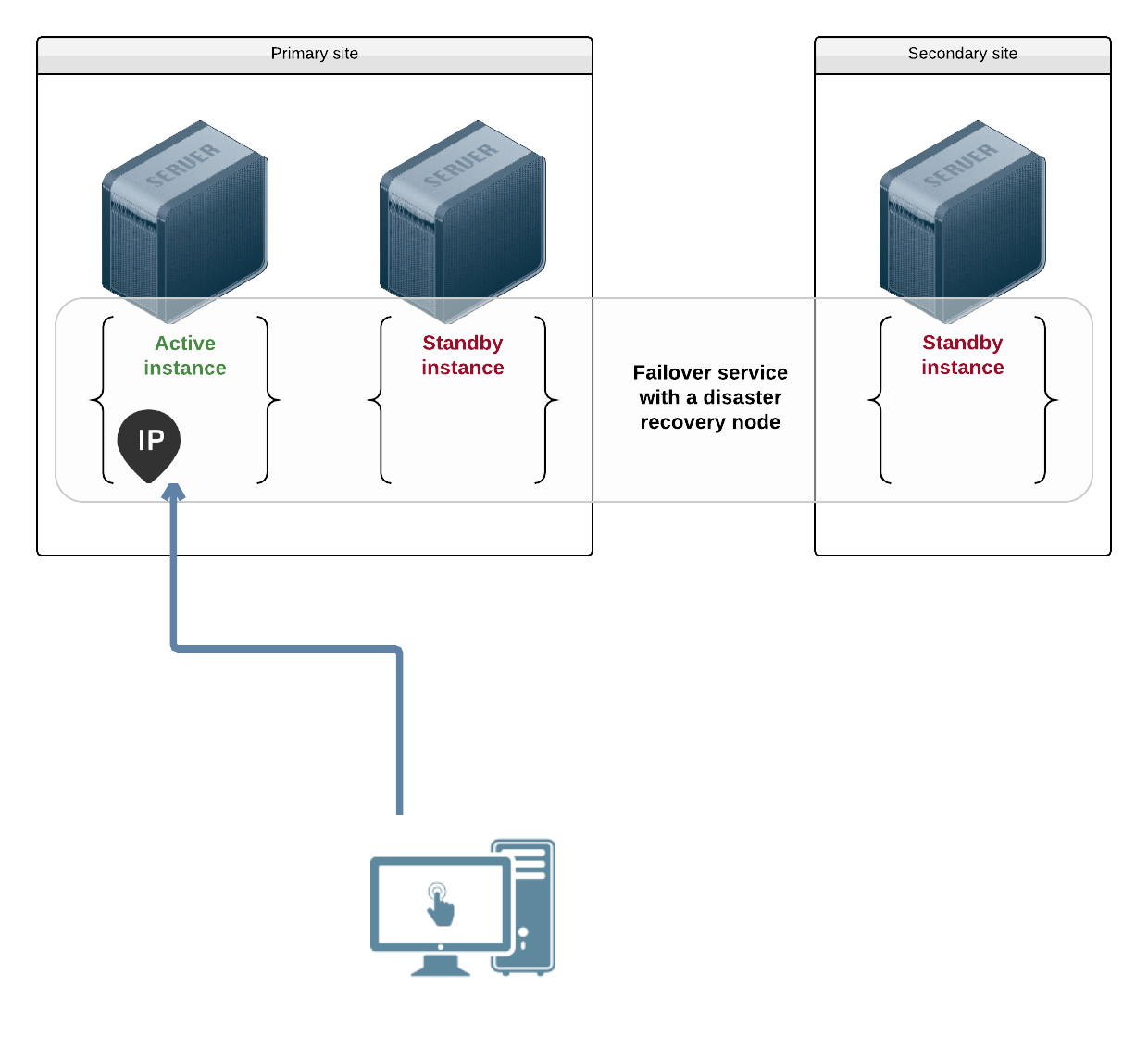
A failover object runs on one node at a time. The other nodes hold a standby
instance, ready to take over. A floating ip follows the active instance, so
clients keep reaching the service at the same address wherever it runs.
A flex object runs on several nodes at once, flex_target of them, within
the [flex_min, flex_max] range. Every instance is active and carries its own
ip, so a load balancer in front of them spreads the clients.
Pick failover for something only one node may own at a time, like a database
writing to a shared disk. Pick flex for something that scales by running more
copies, like a stateless web front end.
Configuration and secrets are objects too, installed into a service’s storage before it starts. See Configs and Secrets.
When the split is decided, each object must be named.
Each object configuration can be designed on a development cluster or namespace. These configurations can be tracked alongside the application code base.
Finally, the configurations can be deployed on test, up to production clusters or namespaces. Usually, these deployments are handled by a CI/CD pipeline.